
 Logos Kit
Worked example: faucet
Test funds into the account the user picks, public or private, with rate limits handled.
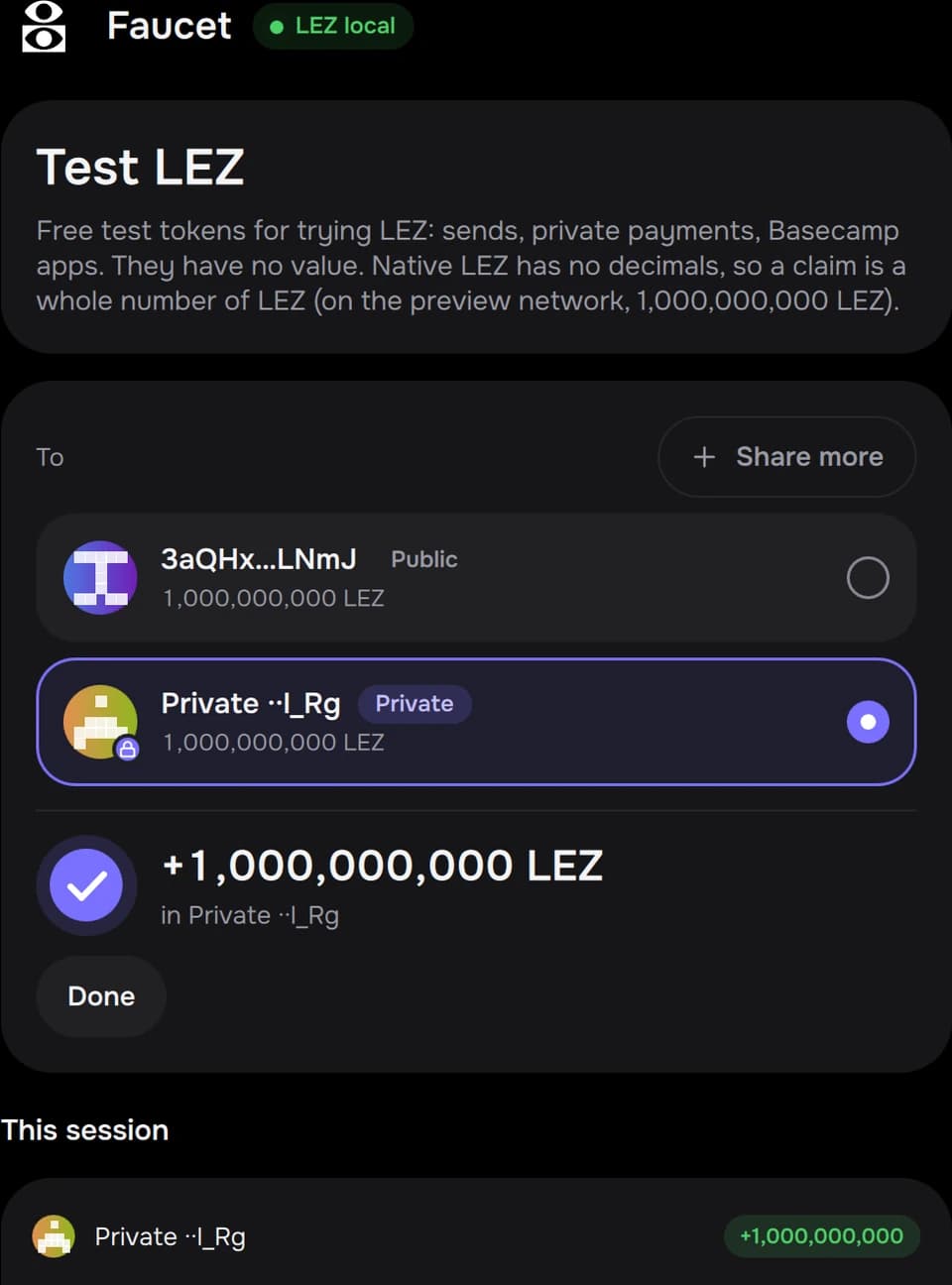
Logos Kit Faucet (modules/logos_kit_faucet) gets test LGO into any
account the user shares. It gives each faucet outcome its own state, including
the ones where it can't tell yet, and the private path, where funds arrive with
a proof.
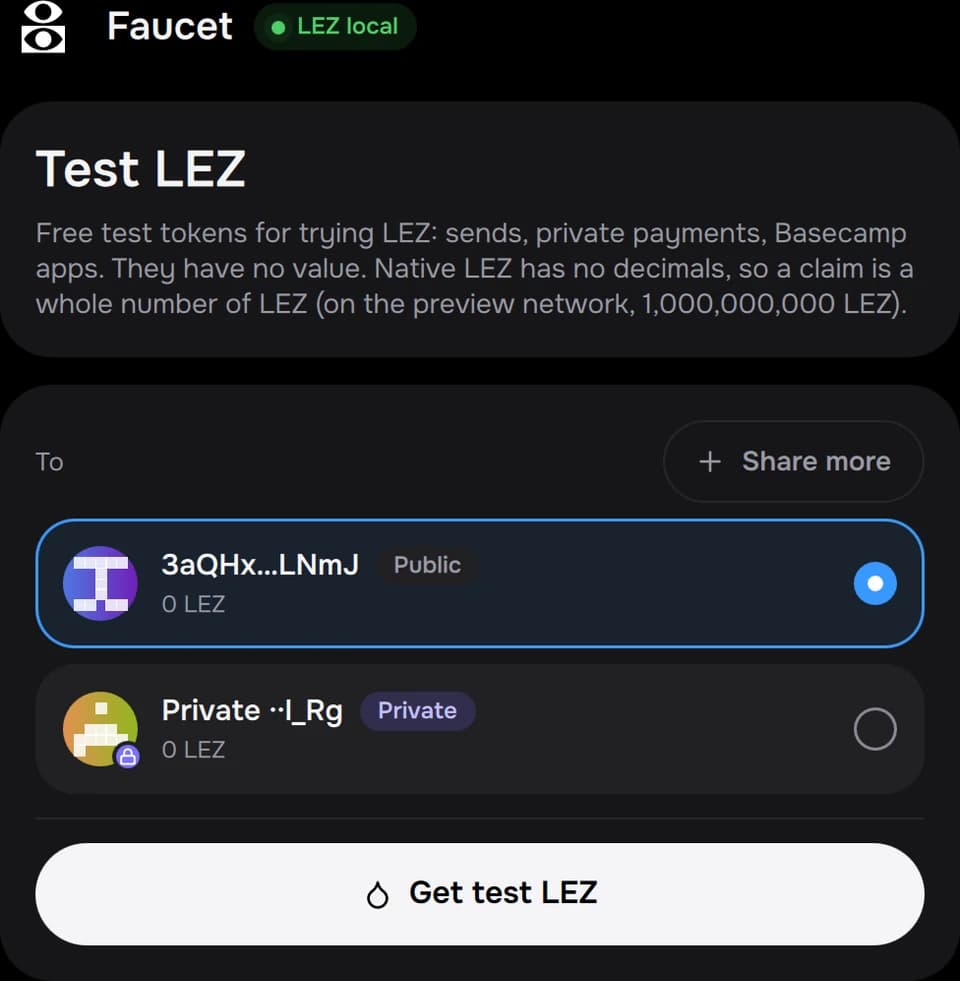
On the official testnet the wallet uses Logos Kit's drip faucet: 1 LGO per request, each account once an hour, each IP five times an hour (Networks).
1. Connect, both kinds
kit.api.connect({ accountKinds: ["public", "private"] })Private accounts need their own consent in the wallet's connect sheet. The app
gets a per-app handle for each (pvt_…); it never learns the account itself.
2. Pick, then request
kit.api.requestFunds(account).then(function (r) {
    if (r.status === "funded")           r.shieldHandle ? follow(r.shieldHandle) : done(r.amount)
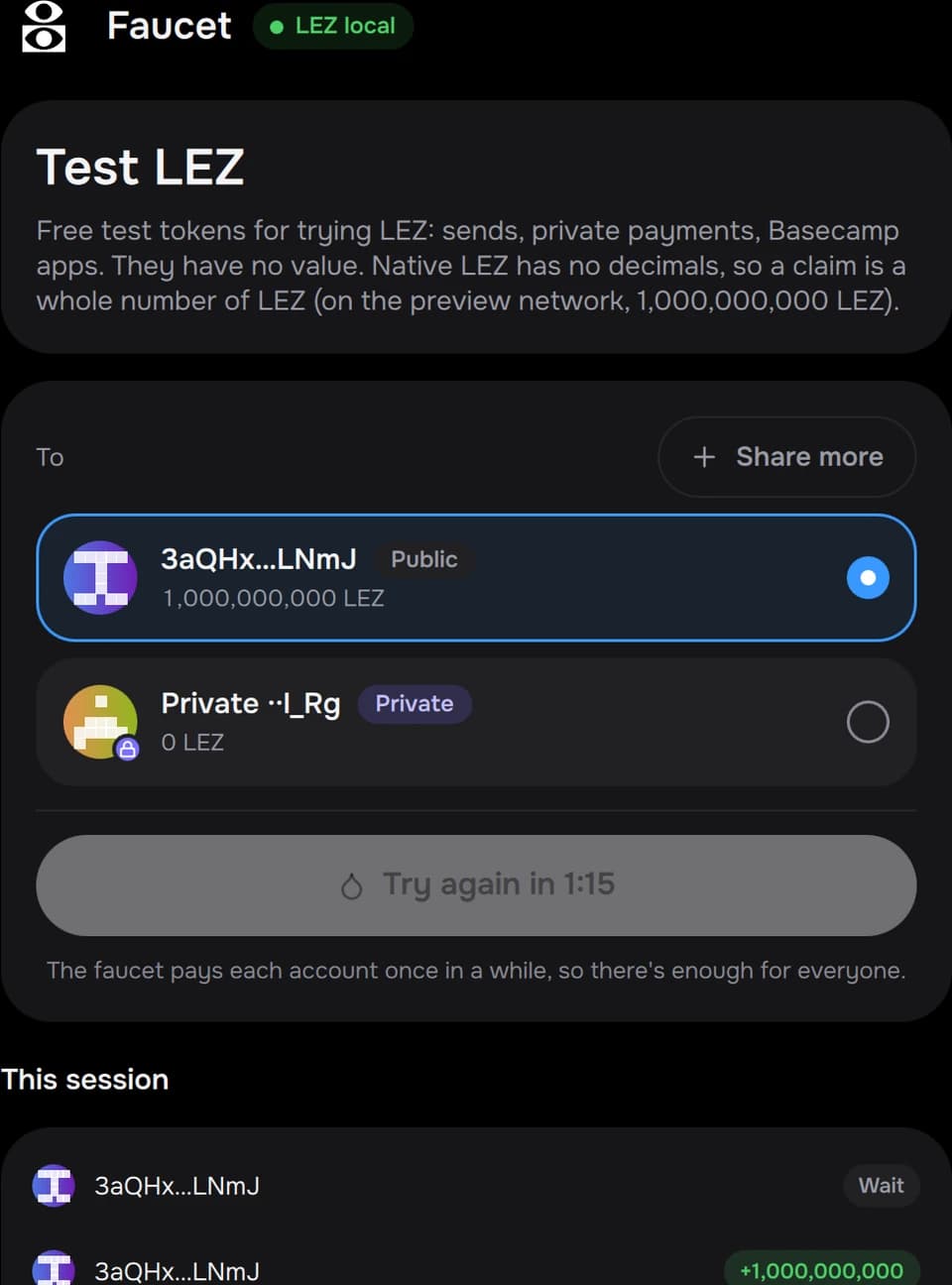
    else if (r.status === "rate_limited") countdown(r.retryAfterSeconds)
    else if (r.status === "outcome_unknown") watchBalance(r.fundedAccount || account)
    else                                  declined(r.reason)
})| Outcome | What the app shows |
|---|---|
funded | the amount (lepta: show kit.sdk.formatUnits(r.amount, 9) LGO), the account, a link to the transaction |
rate_limited | a countdown on the button, which reopens at zero |
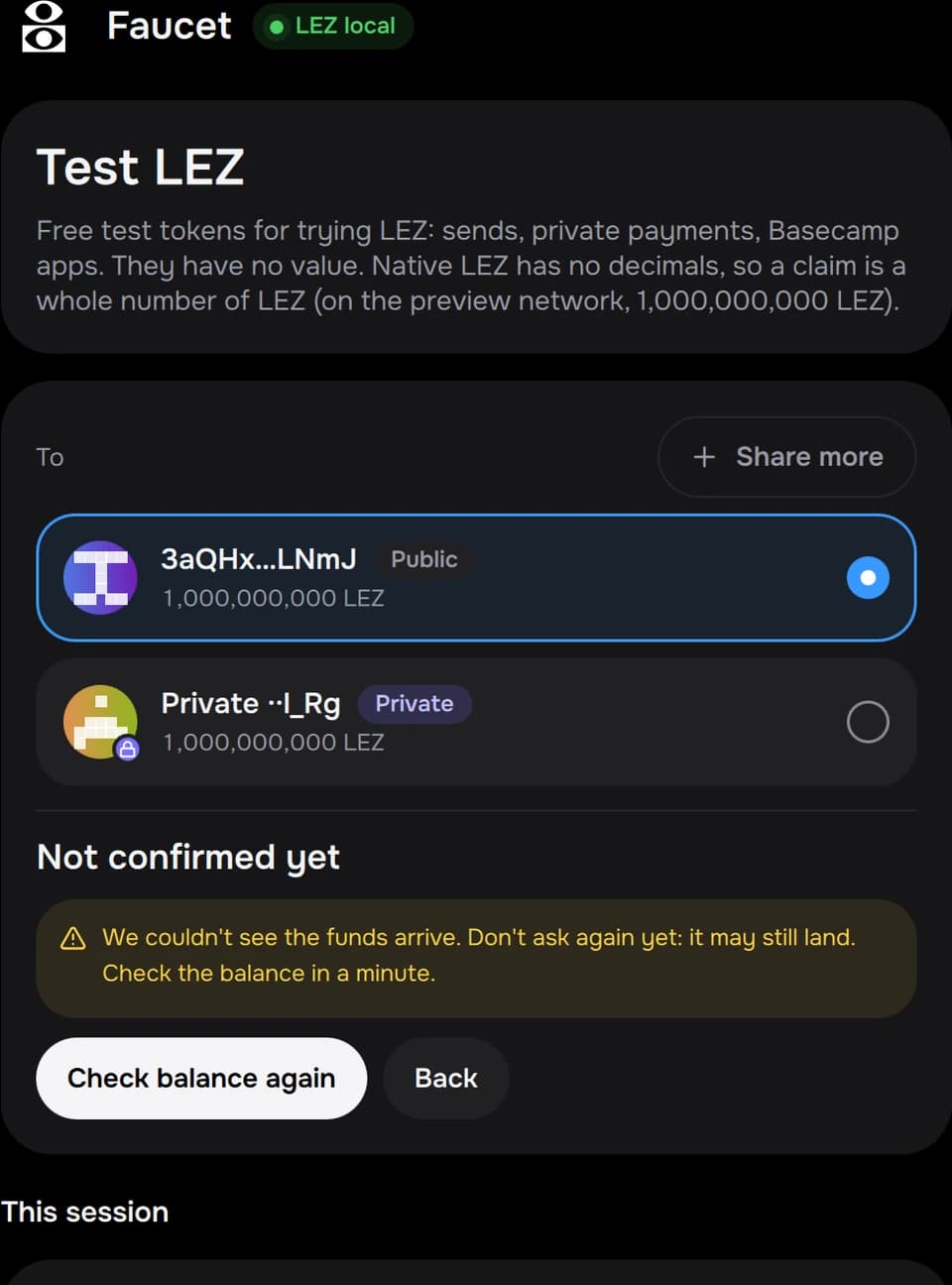
outcome_unknown | "Checking…": it watches the balance instead of asking again (a second request could pay twice) |
rejected | the faucet's reason |
When the outcome is unknown
The faucet answered ambiguously (a timeout, a dropped connection), so the funds may or may not have landed. The app never re-requests on its own. Instead it:
- Re-reads the paid account's balance on a timer, for a bounded time. Each attempt counts, including failed reads, so an unreachable node can't keep it checking forever.
- Shows Funds arrived as soon as the balance goes up.
- Otherwise ends in an unresolved state: "We couldn't confirm the payment", with Check again (one more balance read) and a plain note not to request again until the check settles.
For a private target, the account to watch is not the private one. The
faucet only pays public accounts, so it paid r.fundedAccount, one of the
user's public accounts. The app watches that account and says so ("The
faucet paid Public account 1"). If the funds turn up there, the user can move
them into the private account from the wallet.
3. The private path
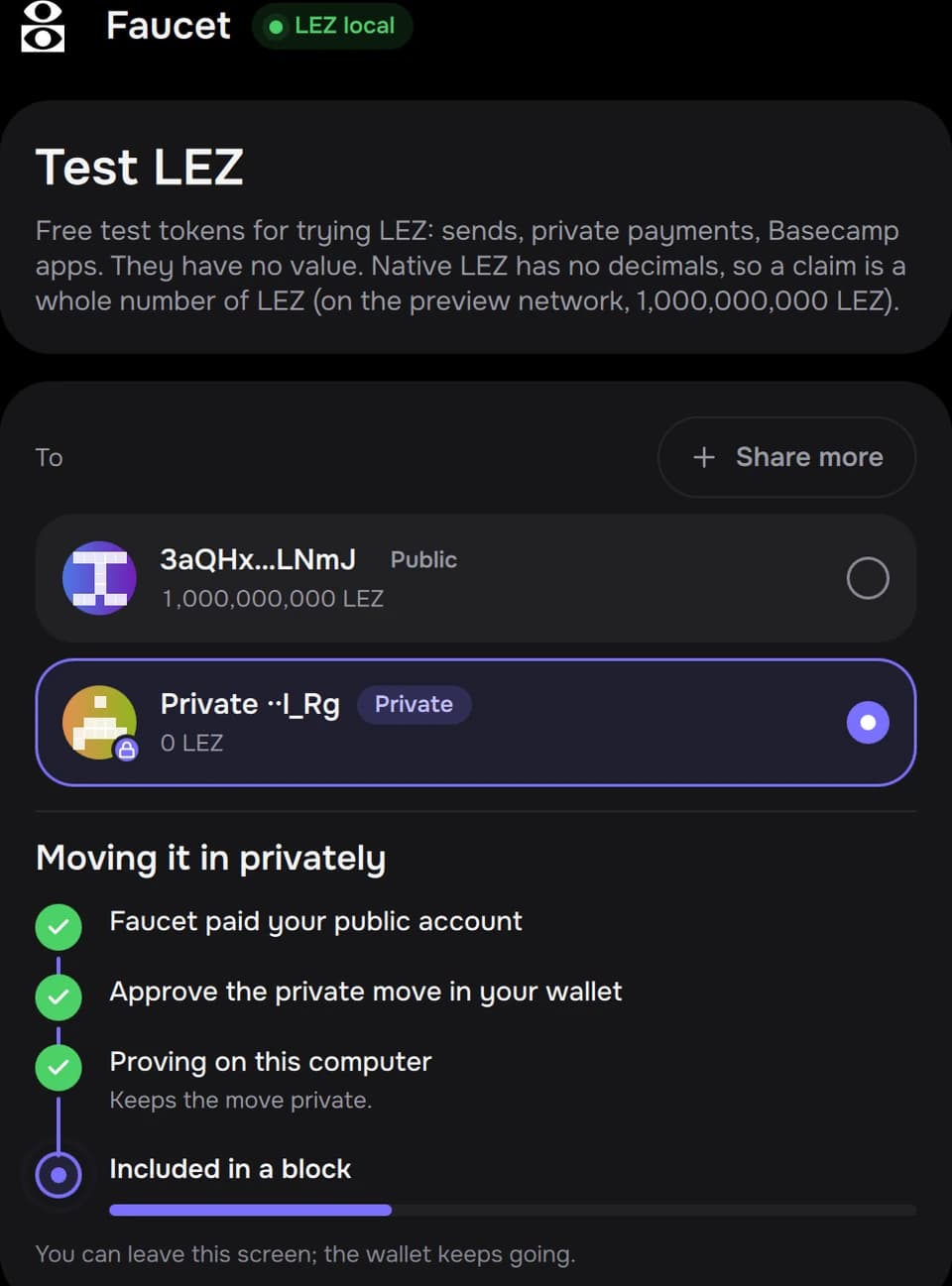
The faucet only pays public accounts. For a private target the wallet funds
one of the user's public accounts (fundedAccount), then queues a transfer
into the private account (a shield), which the user approves in the wallet.
The app follows it with the returned shieldHandle:
kit.api.watchTransaction(r.shieldHandle, function (s) {
    // awaiting_approval → proving (minutes, on the user's machine) → submitted → included
    if (s.lifecycle !== "included") return
    if (s.outcome === "success")      done()           // the private balance moved
    else if (s.outcome === "failure") failed(s)       // funds are still on fundedAccount
    else                              unconfirmed(s)   // included, outcome unconfirmed
})
The app shows four steps (paid, approve, proving with a timer, included). Only
outcome === "success" shows Done. An included shield with outcome unknown
gets its own Included, outcome unconfirmed state, which says the funds are
either in the private account or still on the public one, and offers a balance
check. If the user declines the move, the app says plainly that the funds stay
on the public account.
Run it yourself
e2e/faucet-app.sh # public claim, rate limit, private claim through a shield